
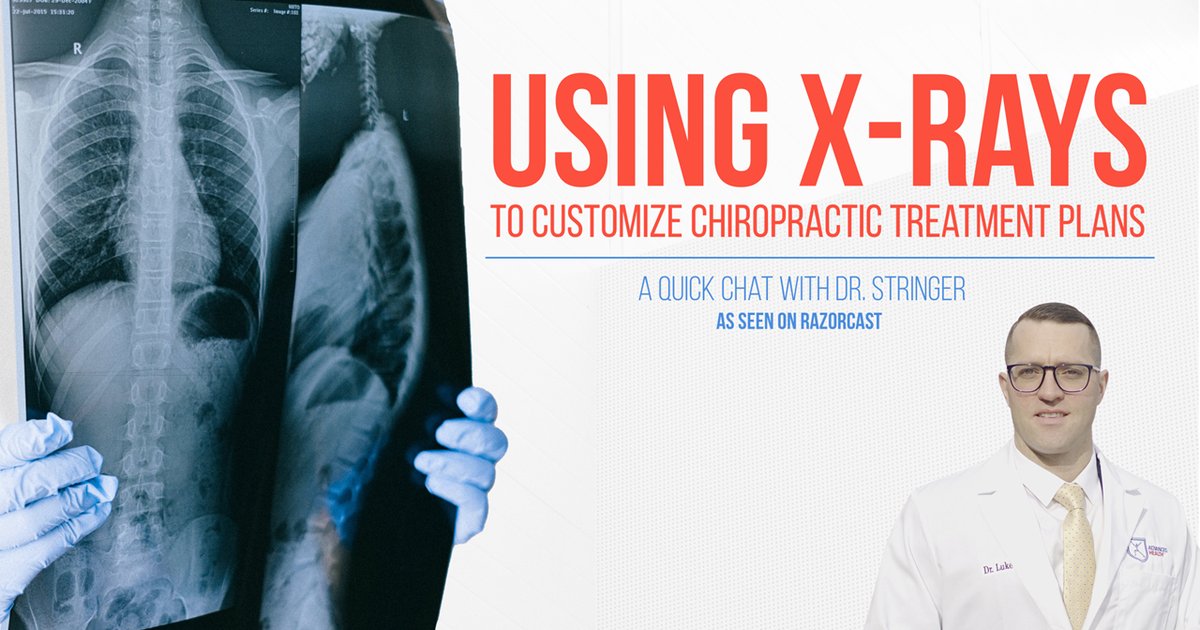
X-rays give us objective data to build your chiropractic treatment plan — and to prove it’s working. In this post, we’ll walk you through how we use digital X-ray imaging, biomechanical software, and specialist review to pinpoint what’s driving your pain, customize your care, and measure your progress from day one to discharge.
Why we take X-rays
We’re an objective chiropractic clinic. That means treatment recommendations are driven by findings, not guesses — and X-ray analysis is one of the most important findings we collect.
X-rays help us do three things:
- Examine the condition of your spine. Is the bone healthy? Are there signs of inflammation, fractures, degenerative changes, or spinal conditions like DISH that change our treatment approach?
- Measure the shape of your spine. This is the biomechanics piece — how your spine is loaded and aligned.
- Show you what’s causing your pain. Most patients leave the report-of-findings visit with a much clearer picture of why they hurt.
How we read your images
We have digital X-ray systems in-office, and our chiropractors are trained to read them. Every X-ray is also sent to a DACBR — a chiropractor who completed several additional years of training to become the chiropractic equivalent of a radiologist. That second set of expert eyes means nothing gets missed.
On top of that, we run your films through software called PostureRay, which digitally analyzes the X-ray and gives us biomechanical feedback down to the millimeter and the percent of shift. That level of detail is what allows us to build a truly customized treatment plan instead of a one-size-fits-all adjustment schedule.
Chiropractic BioPhysics: structure matters
At Advanced Health we use Chiropractic BioPhysics methods, which study the biomechanics — the shape — of the spine. Some patients come in with complex misalignments: the head has shifted forward, laterally to the left, and rotated to the right, all at once. Those are hard conditions to treat, and the setups for traction and corrective adjustments are intricate.
X-ray analysis tells us exactly how to position you, how to load the spine, and what to recheck visit by visit. If a setup isn’t producing the change we expect, we know — and we adjust the approach.
Not just the spine
Any moveable joint in the body can be X-rayed. In the wrist or ankle, we’re checking alignment of the small bones. In the knee, we’re looking at loading patterns, joint space, and degenerative changes. X-ray is still the gold standard for bone, so when something structural is going on in a joint, imaging is the fastest way to find it.
Curious what your X-rays would show? New patients can get a full chiropractic exam plus X-rays for $49 at our South Loop office. Book online at /schedule or call (312) 987-4878 — we’ll walk you through your images and what they mean for your care.
Pre- and post-treatment X-rays
For patients in corrective care, we take X-rays at a minimum at two points: the beginning of the treatment plan, and the end. Then we sit down together and compare the pre- and post-treatment images.
If you’ve been consistent with your in-office care and home traction over those eight to 12 weeks, you’ll see real, measurable change on the films. Patients love that moment — it validates the work they’ve put in, and it’s the best predictor of long-term improvement.
What comes after
Once we’ve documented the structural change, we shift into maintenance. That usually includes:
- A home traction prescription so you can hold the correction you earned in the office
- A sit-stand desk recommendation (we think everyone should be using one)
- Postural breaks throughout the workday — chin off the chest, out of constant flexion
- Targeted rehab to keep the muscles supporting your new spinal alignment
X-rays before and after treatment let us make clear clinical decisions, show you objective proof of progress, and build a maintenance plan that actually fits your spine.
Ready to see what’s driving your pain? Schedule a new patient visit or learn more on our new patients page.
Have a similar concern?
The fastest way to get answers about your specific situation is a New Patient Exam.
Schedule your new patient exam