
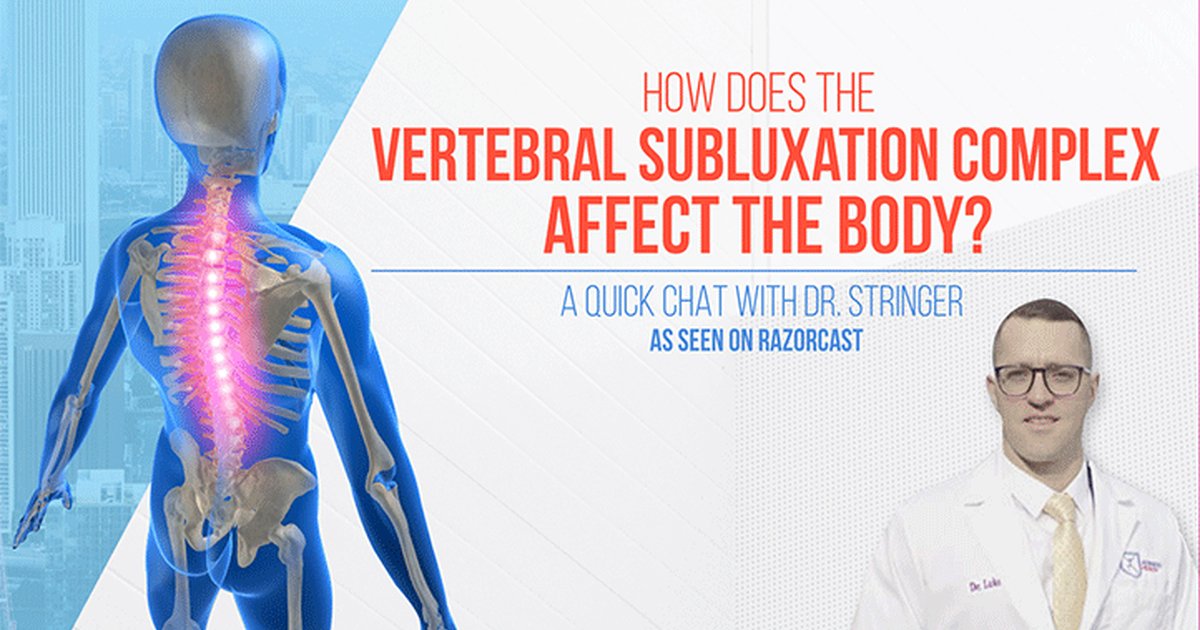
When a joint in your spine stops moving the way it should, it stresses the nerves around it — and that stress can ripple into your digestion, immune system, mood, and energy. That's the vertebral subluxation complex in plain language. Below, Dr. Luke Stringer walks through what it is, how we diagnose it, and what it actually affects in the body.
What is the vertebral subluxation complex?
A vertebra is a joint in your spine. Every spinal joint should move freely and stably through all planes of motion, supported by balanced muscle strength. When that's true, your body has a much better shot at functioning at its best.
A subluxation means a joint has stopped moving the way it should — it can lock up, move abnormally, or shift out of alignment. When that happens, it puts mechanical stress on the joint, surrounding tissue, and the nerve exiting that level of the spine.
The nervous system controls everything you feel and do, so when it's under sustained stress, the downstream effects aren't only pain. We see physical, biomechanical, and physiological problems show up: poor sleep, low energy, mood changes, sluggish metabolism, and yes — pain.
How we diagnose a subluxation
There are a few reliable ways to find a subluxation:
- Range of motion exam. We move the joint through its normal motion. If it doesn't move the way it should, that's a subluxation.
- Instrumentation. The Gonstead technique — developed by Clarence Gonstead in Wisconsin — uses a tool called a Nervoscope that picks up heat differentials along the spine. A compressed nerve generates inflammation and heat, and the Nervoscope helps locate the level involved.
- X-rays. To see is to know. Imaging makes the finding objective and lets us measure global alignment, not just one joint.
That last point matters. A subluxation isn't always a single joint — it can be global. If your entire cervical spine is shifted two inches forward and your neck curve is gone, that's a subluxation pattern across a whole region. Pinpointing where the problem lives — single segment versus global postural shift — decides how we treat it.
Can a subluxation affect your immune system?
Yes. When your spine is shifted or a joint is locked up, your body sits in a low-grade stress state. Chronic stress raises cortisol, blunts insulin reception, and disrupts hormones. A body stuck in that state doesn't fight off illness as well as one that isn't.
It's not that an adjustment cures a cold — it's that removing a chronic stressor on the nervous system lets your immune system do its job.
Can it affect digestion and the GI system?
This is one of the more surprising effects for patients. Here's why it happens:
You have sensory nerves (the ones that send pain signals) and asensory nerves (the ones that don't). Roughly 85% of your nervous system is asensory. So a subluxation that's stressing a non-sensory nerve won't necessarily hurt — but the organ that nerve supplies still isn't functioning well.
Think of a garden hose. Un-kinked, water flows freely. Step on the hose, and water still comes out, just not the way it should. That's what a subluxation does to the nerves feeding your digestive organs, particularly at the thoracolumbar junction — where your lower mid-back meets your upper low back.
We see patients who've already changed their diet and tried everything else. When we find subluxations in that thoracolumbar region and restore motion, gas, irregular bowel movements, and poor digestion often improve.
Wondering if a spinal issue is behind your back pain, fatigue, or digestive trouble? Come in for a $49 new patient exam and X-rays at Advanced Health in the South Loop. We'll show you what we find on imaging and walk you through your options. Book online at /schedule or call (312) 987-4878.
Can it affect brain function?
Movement in your spine creates more than 80% of the stimulation that reaches your brain. So when joints aren't moving, the nerve roots at those levels aren't firing the way they should, and the brain isn't getting the input it expects.
There's interesting research out of Australia using live brain scans before and after upper cervical adjustments — showing measurable changes in how different brain regions communicate after care.
Does a subluxation rewire gray matter? No — major changes there come from trauma and injury. But the loop of signal going out the joint, up the spine, into the brain for processing, and back down? A subluxated, non-moving joint absolutely degrades that signal.
Can chiropractors correct subluxations and restore function?
Yes — this is the core of what chiropractors are trained to do. Every chiropractor is educated as a nervous-system and spinal specialist, and the diagnosis and correction of subluxations is foundational to the work. How a chiropractor corrects it varies by technique and case.
In most patients, we can restore healthy motion to the joint and improve overall function. The exceptions are major trauma, severe degeneration, or congenital spinal issues — and even then, we can often improve quality of life without drugs or surgery.
At Advanced Health, we use Chiropractic BioPhysics methods to address not just single-segment subluxations but the global postural patterns that drive them. That means measuring your spine on X-ray, comparing it to ideal alignment, and building a care plan to move it back toward normal.
Ready to find out what your spine is doing?
If you've been dealing with pain, digestive issues, low energy, or you just want to know whether a subluxation is part of the picture — we can find out. Schedule a new patient visit at /schedule, learn what to expect at /new-patients, or call (312) 987-4878.
Have a similar concern?
The fastest way to get answers about your specific situation is a New Patient Exam.
Schedule your new patient exam