
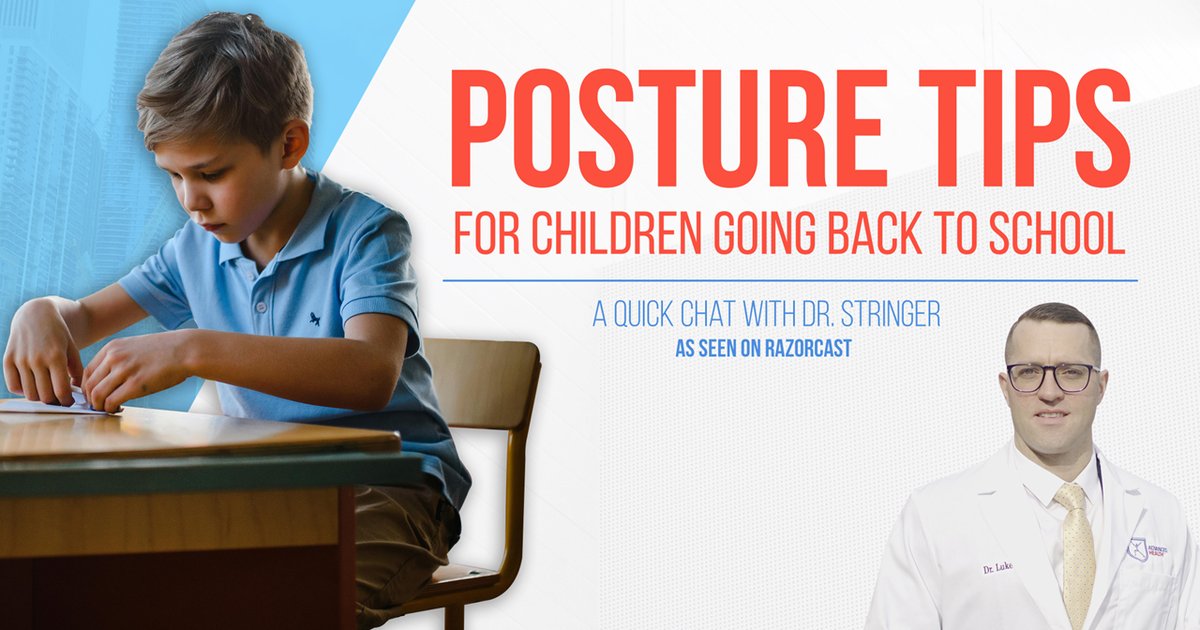
Your child's spine is still developing, and the hours they spend hunched at a desk or hauling a heavy backpack shape how it grows. This post gives you a practical setup for sitting, standing, and choosing a backpack so poor ergonomics don't quietly become poor posture — and the chronic neck, back, and even neurological issues that follow.
Why posture matters more for kids
Kids' spines are bendy and malleable. Posture plays a huge role in how that spine develops over time, and poor posture creates a chronically stressed environment. If your child slouches at their desk every day for years, that micro-stress reshapes their alignment.
The other thing to know: motion is lotion. Even good posture, held too long, is bad for the body. We're bipedal — built to be upright and moving, not pinned to a desk all day. So the goal isn't just "sit up straight." It's good positions, broken up by frequent movement.
How your child should sit
Start at the chair and work up.
- Hips back. Slide all the way back so your child's back touches the chair. Lean back slightly so shoulders sit behind the hips, not in front. When shoulders drift forward into flexion, pressure on the lumbar discs increases by roughly 300%.
- Feet flat, knees at 90 degrees. If the chair is too high, they'll be on tiptoes. Too low, and the knees rise above the hips, which jams the hip and stresses the low back.
- Snug to the desk. Stomach close to (or touching) the desk edge — no reaching forward.
- Shoulders down and relaxed. Elbow at roughly 90-110 degrees, wrist flat and neutral. A desk that's too high forces the wrists up; too low forces them down. Both irritate the wrist, elbow, and shoulder over time.
- Screen at eye level. Looking straight ahead is ideal. A small downward gaze is fine, but use the four-finger rule: there should be no more than four fingers' width between chin and chest. More flexion than that, day after day, is how tech neck starts.
How your child should stand
The sitting position above is a working posture — and your child should only hold it for 20 to 30 minutes at a time. The rest of each hour should be spent standing or moving.
A standing workstation at home is one of the best investments you can make. When standing:
- Weight even through both feet
- Snug to the desk, shoulders down
- Elbow at about 90 degrees, wrist neutral
- Screen raised so the eyes — not the whole head — look slightly down
Most classrooms don't have standing desks yet. At home, you have full control, so build the alternation in: sit, stand, sit, stand, throughout study time.
How to pick the right backpack
The backpack is the other half of this conversation, and it's the one parents most often get wrong. We see kids in the practice with backpacks weighing close to half their body weight. That's a serious problem.
The rules:
- Weight: no more than 15% of body weight. A 100-pound child should not carry more than 15 pounds. Use a luggage scale to actually check — don't guess. Keep textbooks in the locker and rotate them in and out as needed.
- Double straps, always. Single-strap and cross-body bags load one shoulder and pull the spine out of alignment.
- Chest strap. Pull it snug so the pack stays tight to the spine. A loose pack drifts away from the low back and tips your child into extension, which compresses the lumbosacral juncture at the base of the low back.
- Shape matters. A taller, oblong pack lets books sit spine-up/spine-down and distributes weight evenly. We like Bixby for this — they specifically design ergonomic gear for kids.
Worried about your child's posture or back pain from school? Get a new patient exam and X-rays for $49 at Advanced Health in the South Loop. We'll show you exactly how their spine is developing and what to do about it. Book online at /schedule or call (312) 987-4878.
Why small misalignments add up
The spine works in kinematics — when one segment shifts, the rest compensates. If a heavy single-strap bag pulls your child's lower back one way, the head drifts the other way to counterbalance. Over months and years, that shows up as anterior head carriage, a straightened neck, and shoulders sitting behind the hips, compressing the low back.
The consequences aren't only musculoskeletal. In kids especially, prolonged forward head posture and tech neck are linked to neurological and sensory issues — not something you want quietly building during the school years.
The bottom line
Get the desk setup right. Cap the backpack at 15% of body weight, with double straps and a chest strap. Break up sitting with standing every 20 to 30 minutes. If your child is already showing signs of poor posture — rounded shoulders, a forward head, complaints of back or neck pain — don't wait it out. We use Chiropractic BioPhysics methods to measure and correct posture in a structured way, and it's much easier to address while kids are still growing.
Ready to get your child evaluated? Book an appointment or contact us with questions.
Have a similar concern?
The fastest way to get answers about your specific situation is a New Patient Exam.
Schedule your new patient exam