
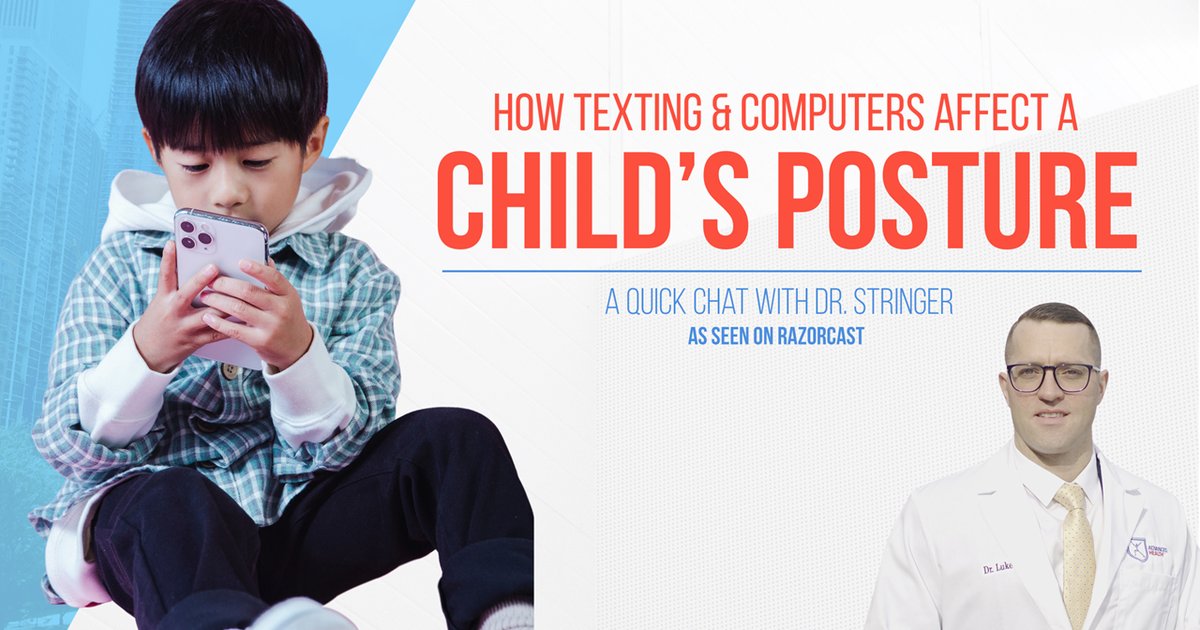
Kids spend hours hunched over phones, tablets and laptops, and that posture takes a real toll on their spines, nervous systems and how they feel day to day. In this post you'll learn how forward-head posture develops, the health and behavioral issues we see linked to it, a quick check you can do on your child today, and the desk setup and exercises we recommend to undo the damage.
Why a hunched-over kid is a bigger problem than it looks
Motion is lotion. Our bodies are designed to move, so any sustained posture — good or bad — becomes a repetitive stress. Over time, muscles, ligaments, tendons and even the bones of the spine adapt to whatever position you hold most.
Picture your head as a bowling ball. Held close to your chest, it doesn't feel heavy. Stretch your arm out and it gets a lot harder to hold up, even though the weight hasn't changed. A child's head weighs roughly 8 to 10 pounds. When the ear sits over the shoulder, the natural curves of the spine absorb that load beautifully. Push the head two inches forward and tilt it down into a screen, and you multiply the stress on every soft tissue in the neck.
That sustained tension triggers what's called the creep effect — the soft tissue literally changes structure to match the posture you keep putting it in. That's how an occasional slouch becomes a permanent forward-head posture.
The four-finger check (do this tonight)
I'm not here to give parenting lessons on screen time. But while your child is on a tablet or phone, here's a quick check you can run:
- Open your hand, palm flat.
- Place your pinky in the notch between the collarbones, at the top of the sternum.
- Bring the chin gently down toward the chest.
If you can't fit four fingers between the chin and the sternum, your child is in too much neck flexion. That's the position that drives the problems below. The same check works for you reading in bed or scrolling on the couch.
What poor posture actually does to a child's body
As chiropractors, we pay close attention to the nervous system, because the nervous system controls how the body feels and functions.
You have two sides to your autonomic nervous system:
- Parasympathetic — "rest and digest." Relaxed state, where you digest food and sleep restoratively.
- Sympathetic — "fight or flight." The state you'd be in if you got rear-ended or chased by a bear.
When a child lives in rounded-shoulder, head-forward posture, the body reads it as chronic stress. Cortisol stays elevated. Cortisol blocks hormone receptors — insulin especially — which affects how hormones regulate everything else. In adults, this looks like poor sleep, low mood, low energy, and trouble managing weight.
In kids, we tend to see it show up differently. A lot of the children parents bring into the clinic have sensory issues, ADD, ADHD, or autism spectrum challenges. Families have often been through every test and medication available, and they're looking for another angle.
When we look at the spine, we frequently find that same posture — head shifted forward, chin down — creating shifts at the top of the neck (C1 and C2). Those two joints sit right under the skull, where the brain stem emerges, and they carry more nervous-system activity than anywhere else in the body. When those joints are subluxated (shifted out of normal position) and the child is stuck in sympathetic mode, it can manifest as trouble concentrating, sensory sensitivity, behavioral issues, and changes in appetite. We see this pattern often enough that it's worth checking the spine before assuming the problem is purely behavioral.
Worried about your child's posture, focus or behavior? Get a $49 new patient exam and X-rays at Advanced Health Chiropractic in the South Loop. We'll look at the spine, the posture and the nervous-system picture together and tell you honestly whether chiropractic care is the right fit. Book online at /schedule or call (312) 987-4878.
How to set up a desk for homework and gaming
Motion is lotion, so the goal isn't a perfect chair — it's variety.
- Use a sit-stand desk. Rule of thumb: 20-30 minutes sitting, 30-40 minutes standing, then switch. This works just as well for homework as it does for gaming.
- Run the four-finger check while your child is at the desk. Chin should sit four fingers off the chest, not on it.
- Take a five-minute postural break every hour. Pause the game, stand up, do a couple of the moves below.
When we're sedentary, the postural muscles get weak and lazy, and the muscles meant for movement try to take over stabilizing the body. That swap is exactly how compensation patterns and poor posture set in.
Two exercises every kid (and parent) should do daily
These are proactive — you don't need to wait until posture is a problem.
Chin tucks
Stand tall and look straight ahead. Draw your chin straight back toward your neck, giving yourself a double chin. Hold a couple of seconds, release. This engages the deep neck flexors that keep the head stacked over the shoulders and preserve the natural neck curve. In the clinic, we sometimes add a yoga block between the shoulder blades to cue better positioning.
Wall angels
Stand with your back flat against a wall. Raise your arms overhead, keeping your wrists and elbows in contact with the wall the entire time. Slowly slide your arms down until you feel a pinch between the shoulder blades, then slide back up. This trains the shoulder-blade retractors that hold the shoulders back where they belong.
We've got walk-throughs of both of these on our YouTube channel, along with more postural breaks for kids and adults.
The takeaway for parents
You don't have to ban screens to protect your child's posture. You do have to:
- Watch for the chin-on-chest position and correct it with the four-finger check.
- Build in movement — sit-stand desks, hourly breaks, daily chin tucks and wall angels.
- Get the spine looked at if you're seeing focus, sleep, sensory or behavioral issues that aren't responding to other approaches.
If you'd like us to take a look, we see kids (and their parents) in our South Loop office every day. Book a new patient visit at /new-patients or call (312) 987-4878.
Have a similar concern?
The fastest way to get answers about your specific situation is a New Patient Exam.
Schedule your new patient exam