
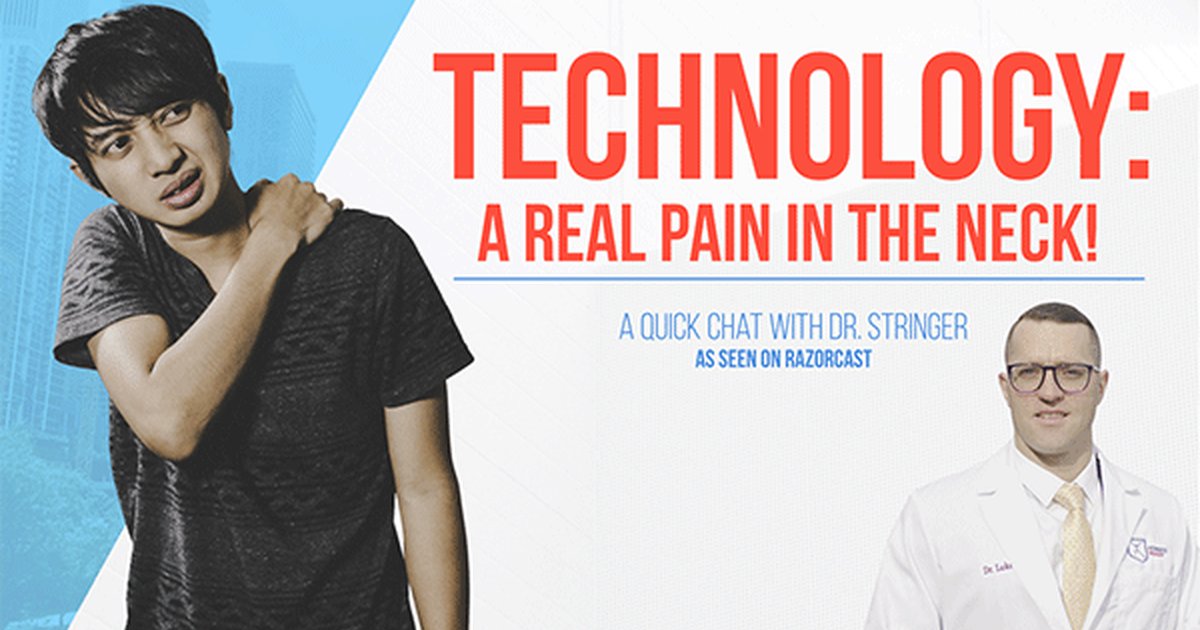
If you spend hours hunched over a phone, tablet, or laptop, your neck is paying for it. "Tech neck" is the forward-head posture that develops when you constantly look down at a screen — and over time it leads to headaches, stiffness, shoulder pain, and even disc problems. Here's what's actually happening to your spine, the symptoms to watch for, and what you can do at home before things get worse.
What tech neck actually is
A healthy neck has a backward curve of around 42 degrees. That curve is designed to absorb the weight of your head — which runs 10 to 15 pounds — and disperse it evenly across the joints, discs, and nerves. When you're standing tall, your ear should line up directly over the AC joint (the bony bump on top of your shoulder).
Now picture a bowling ball. Held tight to your chest, a 10-pound ball feels like 10 pounds. Extend your arms out in front of you and the same ball feels brutally heavy. Same physics applies to your head. Every inch your head drifts forward over a phone or keyboard multiplies the load on your neck.
Do that for hours a day, for years, and the neck loses its curve. The spine straightens out — or worse, shifts forward. That's tech neck. You'll also hear it called text neck or military neck. Radiologists call it hypolordosis. It's all the same thing: a neck that's lost its shape because of how you've been using it.
The symptoms tech neck causes
Symptoms range from mild to severe, and they don't always show up where you'd expect.
Muscle-based pain
The small muscles at the base of your skull — the suboccipitals — anchor your head to the top two bones of your neck. When your head drifts forward, those muscles get pulled tight and break down. That's where headaches, migraines, dizziness, vertigo, and vestibular issues often come from.
Further down, the muscles that connect your mid-neck to your upper back start to overwork. You get the classic dull, achy, stiff neck. Shoulders round forward, the upper back tightens, and you develop what we call upper-cross syndrome — a postural pattern that drives shoulder impingement and upper back pain.
Disc and nerve symptoms
When poor posture goes uncorrected for years, the discs in your neck take on extra pressure. That's when dull ache turns into sharp, stabbing pain — or numbness, tingling, and burning that radiates down your shoulder, arm, and into the hand and fingers. By that stage you're usually looking at degenerative changes in the spine.
The takeaway: catch this early. Three weeks of stiffness is a much easier fix than three years of a numb left hand.
What you can do at home right now
The chin check. Look straight ahead. Place your pinky finger in the notch between your collarbones, just above the sternum. Now bring your chin down until it touches your finger. That's as much forward bend as your neck should do. Next time you're on your phone, check yourself. If your chin is closer to your chest than that, you're in tech-neck territory.
Limit screen time where you can. Easier said than done if you work in front of a monitor all day. But if you can break up long sessions — stand up, look around, move your neck through its full range — your spine will thank you.
Do simple postural exercises. Three to start with: neck retractions, wall angels, and Brugger's exercise. You don't need equipment. Search any of them on YouTube, or check our channel (Advanced Health Chiropractic South Loop) for postural drills you can do at your desk.
Already feeling the headaches, stiffness, or shoulder tension from tech neck? Get a full spinal exam and X-rays for $49 as a new patient at Advanced Health Chiropractic. We'll measure your neck curve, identify what's driving the pain, and build a plan to correct it. Book online or call (312) 987-4878.
Why a chiropractor is the right first stop
Chiropractors are specialists in the spine and nervous system — it's what we spend years in school studying. A reputable chiropractor will take a detailed history, perform a biomechanical exam, watch how your spine moves, and shoot X-rays so we know what we're actually working with. If you're going to build a house, you need blueprints. Same with treating a spine.
From there, we build treatment recommendations around your findings and your goals. At Advanced Health we use Chiropractic BioPhysics methods, which focus on restoring the normal curve of your neck rather than just chasing symptoms.
Chiropractic is a non-drug approach. The U.S. is the most overprescribed country in the world for medications, and most of those prescriptions treat symptoms, not causes. We work the other way around — treat the cause and the symptom resolves with it. That said, there's a time and place for medical care. If you've got severe referral pain, hand weakness, or you're not responding to conservative care, we'll refer you out for imaging, pain intervention, or a surgical consult. Conservative care should be the first door you walk through, not the last.
If you suspect tech neck is the reason your neck, head, or shoulders hurt, get it evaluated before it turns chronic. Learn more about how we treat neck pain or book your new patient visit today.
Have a similar concern?
The fastest way to get answers about your specific situation is a New Patient Exam.
Schedule your new patient exam