
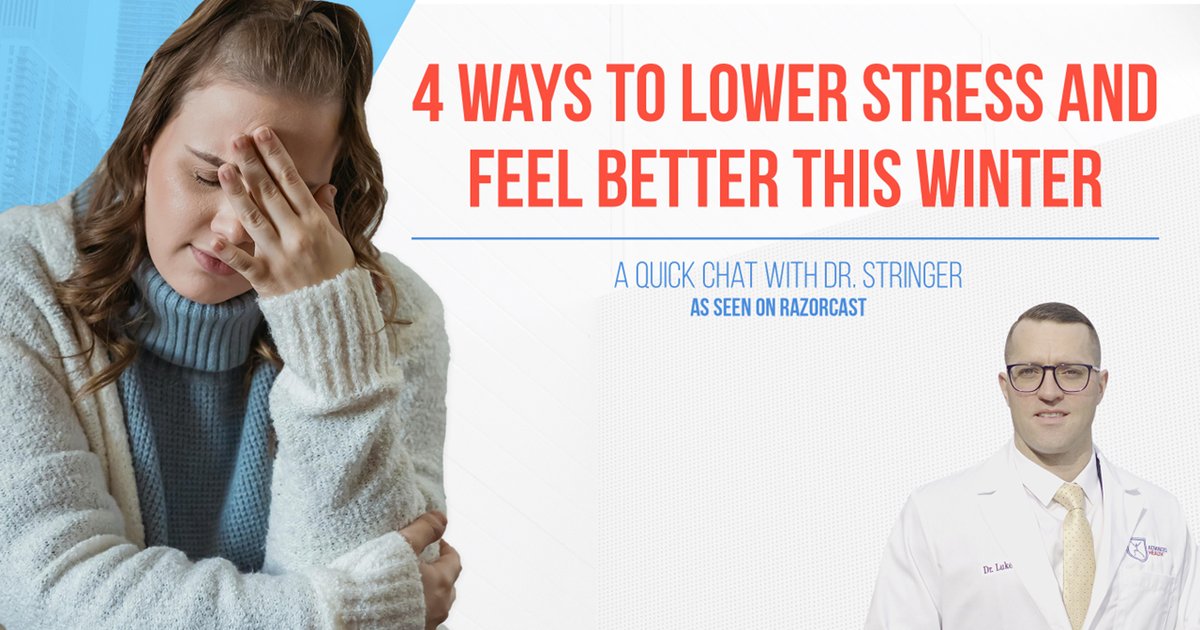
Winter in Chicago means less movement, more sitting, and more stress stacking up in your spine and nervous system. Your body isn't built to be sedentary, and when you can't get outside, postural misalignments, joint stiffness, and elevated cortisol can pile on fast.
Here are four things you can do this winter to lower stress, move better, and feel like yourself again.
1. Maintain proper posture
Most head, neck, and upper-back tension comes from structural misalignment. Spending the day looking down at your phone creates tech neck — your head shifts forward and the natural curve in your neck flattens out. That puts stress on the muscles, pressure on the discs, and tension on the nerves.
When you stop moving, things get worse. Your head drifts forward, your shoulders round, and your core gets lazy. Taking each joint through its full range of motion stimulates the disc, joint, and surrounding tissue.
A few times a day:
- Do simple spinal and joint mobility drills.
- Engage the deep neck muscles that hold your head back over your shoulders.
- Activate your core to stabilize your low back and pelvis.
Balanced strength plus a joint that moves well equals less postural stress — and that's how you feel and function better.
2. Get direct sunlight
Dr. Andrew Huberman, a Stanford neuroscientist, points to roughly 20 minutes of direct morning sunlight as having a meaningful effect on mood, energy, and sleep. The sun still shines in winter — it's just cold.
Bundle up, get outside three to five times a week, and walk for 20 minutes. Don't stare at the sun, but let the light reach your eyes naturally. You'll feel better than you would sitting inside under artificial light.
3. Exercise
Motion is lotion. Twenty minutes of movement releases endorphins, lowers physiological stress, and supports cardiovascular health.
If you can't get outside, use what you have — treadmill, bike, Peloton, elliptical. Just move for 20 minutes a day.
When you do train, focus on the joints you actually use in winter activities like walking, shoveling, or skiing: hips, low back, knees, ankles, and shoulders. Take each one through its full range of motion in every plane.
A prerequisite for any healthy joint is full range of motion. Once you lose it, stress and tension on the joint go up fast. After mobility, train the muscles that stabilize the joint — diaphragm and core for your low back, glutes and hamstrings for your hips and pelvis — so stability shows up when you move.
Our YouTube channel, Advanced Health Chiropractic South Loop, has spine and core exercise videos you can follow at home.
Feeling stiff, stressed, or run down this winter? Get a $49 new patient exam and X-rays at Advanced Health Chiropractic in the South Loop. We'll look at your posture, your spine, and where stress is showing up in your body. Book online at /schedule or call (312) 987-4878.
4. Get chiropractic care
Chiropractors work directly on stress — and stress shows up in more ways than people realize. It can come from a tough work environment, poor diet, or physical strain on the spine.
When we adjust your spine, we improve the range of motion in the joint. Less restriction means less mechanical stress and tension. There's also growing research showing that spinal adjustments influence brain activity and how the nervous system regulates stress.
Cortisol is a big piece of this. When you're stuck in a stressed state, cortisol stays elevated, which interferes with insulin, hormone balance, and overall physiology. Adjustments have been shown to help regulate that stress response.
It's not just about pain
Most patients come in for some kind of pain, but during our deep history we almost always uncover other issues we call conditions. Only about 15% of your nerves can send a pain signal — the other 85% can't. So stress in the nervous system tends to show up as something else.
For the corporate athletes we treat in downtown Chicago, that often looks like:
- Poor sleep
- Low libido
- Fatigue and irritability
- Mood swings
- Trouble gaining or losing weight
When we reduce stress on the nervous system through consistent care, the body starts functioning closer to its optimal rate. Sleep improves. Energy comes back. The things you wouldn't expect a chiropractor to help with often shift first.
Talk to anyone who's been under chiropractic care for a while and you'll hear the same thing: it does a lot more than relieve pain.
Ready to feel better this winter?
If winter is stacking stress onto your spine and nervous system, we can help. Learn more about our approach on the new patients page, or book your visit and we'll get you in.
Have a similar concern?
The fastest way to get answers about your specific situation is a New Patient Exam.
Schedule your new patient exam